Why Do I Feel Like I’m Not Good Enough as a Therapist?
If you feel like you’re not good enough as a therapist, you’re likely experiencing imposter syndrome combined from living in the panic zone of learning. This happens when responsibility outpaces structure. The solution is not more techniques, but better systems thinking to understand what is actually influencing your work.
Why do I feel overwhelmed and unprepared as a new therapist?
What you’re feeling is often called imposter syndrome. But more often than not, it’s actually something simpler. You’re in the panic zone of learning. A not too comfortable reality of being new at something!
Think of your growth in three zones:
Comfort zone, you know what you’re doing! In fact, you may even feel bored. This is the space you find yourself in after time, and struggle, have gifted you with familiarity and skill.
Learning zone, you’re stretching, but still grounded. This is the range of learning where struggle is noticed, but it is inspiring, or at the very least, satisfying to feel yourself on the edge of getting it right and understanding how to repeat the knowledge, or skill, with success
Panic zone, everything feels unclear, fast, and high-stakes. No learning happens in this space, and as the name implies, nothing get’s done effectively either. This is likely what has you googling, or using AI, to tell you what to do next as opposed to trusting your training, and yourself. Most new therapists skip right over the learning zone and land here. I know I did!
The goal isn’t to eliminate the panic. The goal is to build enough structure to move yourself back into the learning zone. And that starts by understanding something most clinicians were never taught! What’s actually influencing your work in the first place.
The Caseload Ecosystem: A simpler way to understand everything affecting your work
Before you assume you’re the problem, zoom out. Therapy doesn’t happen in a vacuum.
Every session is shaped by multiple layers of influence happening at the same time. This is why the panic zone is happening. You don’t yet know which layers are your strengths, and which ones have snuck into your blindspots and are creating such fear and doubt. Think of it like a set of nesting dolls.

1. The Client (The smallest doll)
What they bring into the room, more specifically, why they are coming to you for therapy. Clients bring with them their history and context, and it becomes your job to help organize their wants and needs. It is helpful to know you’re not starting from zero. You’re stepping into a system that already exists. Clients come to you with already established,
Values, core principles that guide a person’s decisions, priorities, and sense of meaning. Values shape what matters most to a client and influence the direction of their goals in therapy.
Beliefs, thoughts and assumptions a person holds about themselves, others, and the world. These can be helpful or limiting and often influence emotions, behaviors, and patterns in relationships.
Emotional capacity, a person’s ability to experience, tolerate, and process emotions without becoming overwhelmed or shutting down. It affects how deeply a client can engage in therapeutic work.
Resources and limitations, the internal and external supports a client can draw from, such as coping skills, relationships, finances and more that provide them with a sense of stability. Limitations are the barriers that may impact progress, such as stress, time, health, or access to support.
2. The Therapeutic Relationship (The next largest doll)
This is where most new therapists put all the pressure unknowingly. It’s not just the client.
It’s:
Your environmental influences, such as your place of work, the payors you accept to provide treatment, the current socio-political climate, and so much more.
Your clinical skillsets, for example, your evidence-based modalities you have exposure to and/or are learning.
Your Caseload Operating System, the way you structure and lead your clients through their therapeutic care inside and outside of the therapy room.
Your personal wellbeing, or in other words, your human-self, not just your clinical-self!
3. Community Context (The next largest doll)
What exists outside the therapy room for your client, such as:
Family dynamics
School or work environment
Towns and counties
Culture and identity
Social support, or the lack of it
And so much more
Sometimes what looks like “resistance” is actually context.
4. Payor + State Systems (The next largest doll)
This is oftentimes a bigger influence than what early career therapists realize. Whether you are working within hospitals, non-profit agencies, grant-based programming, the school setting, or private practice, your work will have expectations put in place that will dictate what kind of care you provide and how, and what will be demanded of you as a mental health provider as well. Think of things like:
Insurance requirements
Session limits
Documentation demands
Access to care
These shape how clients can meet with you as their therapist, how often clients can be seen each week, how long sessions can go, in what ways documentation must be performed, and how long they can remain in care with you and in your setting until they are required to be discharged.
5. Federal + Cultural Systems (largest doll)
This is the biggest layer, and ironically, often the least visible to you in direct-line work. This will include things like,
Policy and legislation, the laws and regulations that shape how mental health care is delivered, including access to services, insurance coverage, confidentiality, and clinical requirements.
Economic stress, the financial pressure a client experiences, such as income instability, debt, or cost of living, which can directly impact mental health, treatment access, and consistency in care.
Societal expectations, the cultural norms and pressures that influence how individuals think they “should” behave, feel, or succeed, often shaping identity, self-worth, and decision-making.
Collective access to resources, the availability of support systems like healthcare, education, housing, and community services, which can either support or limit a client’s ability to engage in and benefit from therapy.
Your client doesn’t walk into a session untouched by the world, and neither do you.
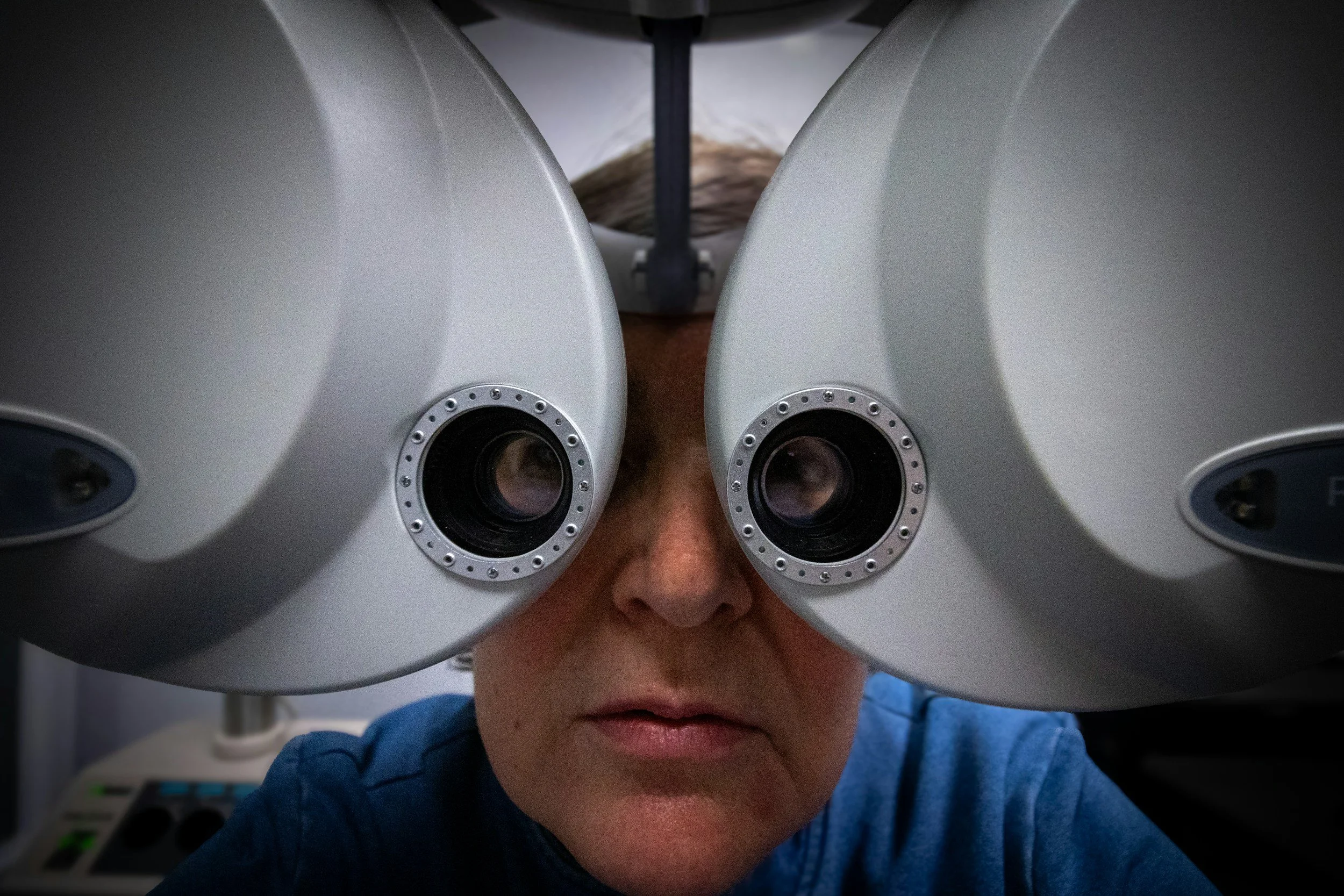
How to “flip lenses” like an eye doctor in session
Right now, most new therapists use one lens, which is usually “Am I doing this right?!” Unfortunately, that lens creates pressure. Fast. And it kills curiosity and learning.
What you can do instead is start flipping lenses like an eye doctor trying to find your prescription, to help you find clarity of vision, of sight. An eye doctor doesn’t panic when the first lens is blurry. They simply ask, one, or two? Click, click, click. They adjust. Flip. Refine. Most importantly, they ask for feedback and keep moving forward. Clarity comes from analysis and reflection, not perfection on the first go.
Let’s draw some inspiration from our friendly neighborhood optometrist!
Ask yourself:
Is this a skill issue… or a system issue?
Is this client resistance… or a mismatch in their environment?
Is this about me… or about the structure I’m working within?
You don’t need one perfect answer. You need better ways of seeing the situation. You need to learn how to see the systems within you and in the work you are doing with your client.
How do I feel more confident as a new therapist?
To feel more confident as a new therapist, focus less on mastering more techniques (still prioritize this, just don’t let it be the only priority) and more on understanding what is influencing your work. Confidence grows when you can clearly see your client, your role, and the systems shaping the therapy process. Structure and awareness reduce overwhelm and improve clinical decision-making.
How do I feel less anxious, imposter syndrome, and burnout as a New Therapist?
When everything feels like it depends on you, of course you feel overwhelmed! When you understand the system, something shifts. You stop trying to control everything, or be prepared for everything. You can start learning how to navigate what’s actually in front of you, and help your client do the same within a safe relationship.
When you zoom out, the nesting dolls start to click. Your client isn’t the only thing in the room. Neither are you. Every session is shaped by layers, your client’s inner world, your relationship with them, and the systems surrounding both of you. And inside of that, your Caseload Ecosystem is always at play.
Your environment.
Your clinical skillset.
Your Caseload Operating System.
Your personal wellbeing.
This is what you’re actually navigating. Not just a session, a system. That’s why the eye doctor analogy matters. You don’t need to get it perfect on the first try. You flip lenses. Adjust. Refine. Until things come into focus. And as your clarity improves, something shifts.
You stop asking, “Am I good enough?”
And start asking, “What am I seeing, and what does it need?”
This is how curiosity builds confidence.
You’ve got this! And when it feels like you don’t, The First Caseload Membership is here to help you build your systems thinking in a community that’s learning, reflecting, and figuring it out together.
References
Vygotsky, L. S. (1978). Mind in society: The development of higher psychological processes. Harvard University Press.